The Collective Negotiation Agreement (CNA) Incentive, often called the CNA bonus, is a one-time cash benefit for qualified government employees in the Philippines. The amount can go up to ₱30,000 per employee, depending on an agency’s actual savings. This incentive is meant to reward employees for helping improve work processes, save government funds, and meet performance targets. It is not automatically fixed—each agency computes the amount based on the savings they generate.
According to the guidelines issued by the DBM, the CNA bonus is scheduled for release not earlier than December 15. Many employees wait for this every year, and it can feel confusing because each agency has different rules and timelines. Regardless, even if you’re new to government service or only worked part of the year, you may still receive a pro-rated amount, so you can still look forward to receiving this.
What Is the CNA Incentive?
The CNA Incentive is a benefit given to employees of government agencies that have a valid and successfully implemented Collective Negotiation Agreement (CNA). It serves as recognition for employees’ efforts in:
- Meeting performance targets
- Supporting cost-cutting measures
- Improving systems and efficiency
- Helping generate savings from MOOE (Maintenance and Other Operating Expenses)
The amount is not predetermined because it depends on the savings generated through these improvements.
Features
The incentive program offers:
- Maximum amount: ₱30,000
- Release window: Not earlier than December 15 and not later than December 31
- Payment: One-time annual benefit
- Pro-rated share: Yes, for employees who worked only part of the year
- Source of funds: Savings from allowed MOOE items only
Target Beneficiaries
Employees who may qualify for the CNA bonus include:
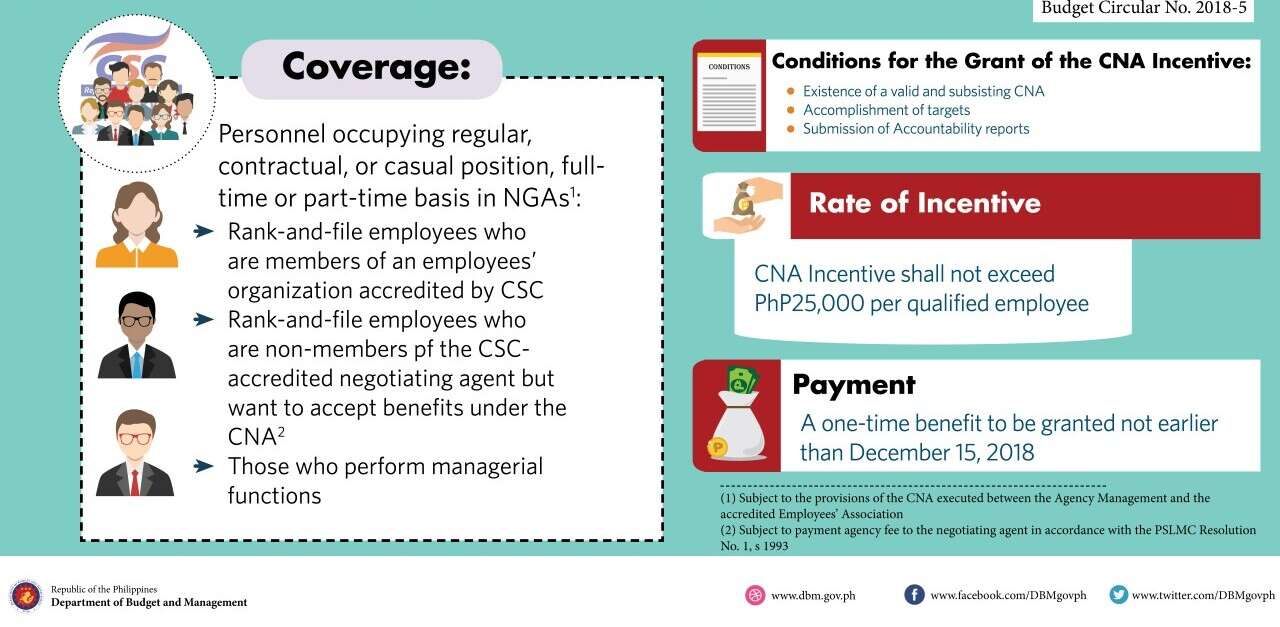
- Civilian government employees in national government agencies (NGAs)
- Employees in Constitutional Offices with fiscal autonomy
- Personnel of State Universities and Colleges (SUCs)
- Employees of Government-Owned or Controlled Corporations (GOCCs)
- Workers in Local Water Districts (LWDs)
- Employees of Local Government Units (LGUs)
- Regular, contractual, and casual civilian personnel
- Management and rank-and-file employees covered by a valid CNA
- Employees who are members of the accredited employees’ organization (or those who pay the required agency fee)
Eligibility Requirements
You and your agency must meet the following conditions:
Agency Requirements
- Existence of a valid and subsisting CNA with an accredited employees’ organization
- Accomplished at least 75% of performance targets as of September 30, 2025
- Savings must come from allowable MOOE items
- Communication Expenses
- Repairs and Maintenance Expenses
- Supplies and Materials Expenses
- Transportation and Delivery Expenses
- Traveling Expenses
- Utility Expenses
- Printing and Publication Expenses
- Advertising Expenses
- Subscription Expenses
Note: Not allowed items include personnel services, capital outlay, discontinued programs, or goods/services meant for clients
- Submitted accountability reports as required
- Committee must verify qualification and recommend distribution to the agency head
- Agency Head must approve the CNA incentive
Employee Requirements
- Must be part of qualified civilian positions (regular, contractual, casual; management or rank-and-file)
- Usually must be a member of the accredited employees’ organization or pay an agency fee
- Must have rendered service within the year (pro-rated if partial)
Guidelines for Employees
If you work in a national government agency, GOCC, SUC, LGU, or LWD, simply follow these steps to check if you are eligible for the CNA incentive:
Step 1. Check if your agency has a valid CNA with an accredited employees’ organization.
Step 2. Confirm your membership status (or if you need to pay the agency fee).
Step 3. Stay updated with your HR or union announcements for internal guidelines.
Step 4. Monitor your agency’s performance—targets must reach at least 75%.
Step 5. Ask your HR if your service period qualifies you for full or pro-rated pay.
Step 6. Wait for official release dates—no earlier than December 15.
Note: Make sure to keep in touch with your HR or union, follow the internal rules, and stay aware of the official DBM circulars so you won’t miss your bonus.